

Table of Contents
- Irrigation Problems with a Properly Maintained Lawn
- 6 Signs of Trouble
- Conduct Daylight Inspection
- Catch Can Test rather than Estimating
- Match the symptom to possible reason
- Analyzing the controller, rain sensor, and schedule
- When a Minor DIY Repair Is Justified
- When Professional Diagnosis Is Helpful
- Homeowner Troubleshooting Checklist
- FAQs
- Final Thoughts
A lawn that has turned brown doesn’t necessarily mean that it’s time to water it more. High temperatures, porous soil, and rainfall are reasons behind browning. This includes possible landscape changes as well as plugged heads and faulty distribution of water. The end goal is to find out whether it was not watered enough, too much, or if water leaves the area too soon.
It might be a good idea for homeowners to consider hiring professionals for sprinkler system repair in Palm Beach County, FL at Sprinkler Contractors of Palm Beaches LLC if there are indications of malfunctioning sprinklers, wet areas, controller problems, or persistent issues with the coverage.
Their residential sprinkler repair business is located in West Palm Beach and mainly includes identifying problems with sprinkler heads, valves, wiring, pressure, valves, rain sensors, and leaks throughout Palm Beach County.
Irrigation Problems with a Properly Maintained Lawn
The irrigation system may not work but have poor results. A sprinkler head being tilted may create problems due to the water coming out on one side of the lawn. A hedge may also interfere with the spray reaching the grass and a broken nozzle may lead to dry grass in some areas of the lawn. Even though the watering timer may be set to run for more extended periods, it does not mean that other parts of the lawn will not suffer from excessive wetness or that the initial issue has been addressed.
The starting point for understanding the problems is treating the lawn like a map. Look for patterns: for example, a dry and thin stripe near the driveway can indicate a misaligned sprinkler head. If there are round patches around the sprinkler, the problem may be that its nozzle is clogged or it does not rise above the level of the grass. A wet spot may indicate that there is leakage.
6 Signs of Trouble
- Brown or dry patches: The same dry areas have become dry after it was supposed to have received water.
- Water puddles: There is water around the sprinkler, valve box, or other low spots that were supposed to be watered.
- Overspray: Water sprays onto sidewalks, driveways, homes, and buildings instead of onto plants and shrubs.
- Zone does not operate: The zone appears to be activated, but the sprinklers remain inoperative.
- Weak spray: The coverage is not as it should be.
- Sudden increase in usage: A leak could be causing an increase in the consumption of water.
Conduct Daylight Inspection
Activate a zone during the day so you can check how it functions. Inspect individual heads for any problems such as cracks, missing parts, clogged, or below the ground. Remove sod, mulch, or soil that has prevented heads from emerging. Make sure there’s no interference from new plantings or patio furniture.
After turning off the zone, check the area. There may be some water draining from the lower head, but if water keeps bubbling, something else may be wrong. Keep pets and children away from the valve box, exposed wires, and wet electrical components.
Catch Can Test rather than Estimating
A catch can test provides an accurate measure of how well a zone is irrigated. Set up five to ten canisters evenly across the area being irrigated and run the system long enough to obtain measurable water volumes in the cans. The University of Florida publishes a great guide on how to run and maintain irrigation systems, including where to place the catch cans.
Any large differences between the volumes of water collected in each can indicates there might be something as simple as a blocked nozzle or wrong spacing involved in the operation. This test is also useful to reveal potential problems with wetting that may be due to poor scheduling. If there is consistency in the water collected in the cans, but the lawn is still poor, check for drainage issues, soil compaction, insect infestations, disease, or the state of the grass instead of thinking about the necessity of adding one more irrigation cycle.
Match the symptom to possible reason
Dry patches near the edge of the zone.
Check for a missing sprinkler, nozzle turned away from the lawn, the head sunk in or landscape blocking the spray. Adding time will not help, as water will not reach the edge of the zone.
A sprinkler head leaks after the shutoff.
Check if the head is damaged and see what happens after the water stops flowing. Ongoing leaking may be due to a damaged part, a broken head, low-head drainage, or a valve that does not seal properly. Wet soil for a long time can ruin plant roots and create muddy surfaces next to hardscape.
What if one zone is not functioning?
Before anything else, check if other zones are functioning correctly and that your controller has the right time, date, start times, and watering days. One zone not working properly could mean that the valve is stuck, the solenoid is dead, there is a wire issue, or the controller is programmed incorrectly.
Weak or misty spray
If the spray is weak, it could be due to many reasons such as a clogged nozzle, a broken filter, limited flow, or too many heads opened in one zone. If there is mist, it is usually because the pressure is too high and the water doesn’t reach the grass but rather drifts away.
Analyzing the controller, rain sensor, and schedule
A controller is only going to execute commands given to it. Make sure the schedule is unchanged after the power outage and the season adjustments are not too much. Also, pay attention to the rain sensor and look for any signs of dirt or damage.
When a Minor DIY Repair Is Advised
- Make sure to clear any debris that is present on the removable spray nozzle.
- Ensure that there are no grass or mulch obstructing the pop-up head.
- Fix any sprinklers that are positioned incorrectly.
- The pop-up nozzle can only be replaced once you have a complete understanding of the type and size of the nozzle.
- Adjusting the controller will be done after ensuring that the adequate coverage has been achieved.
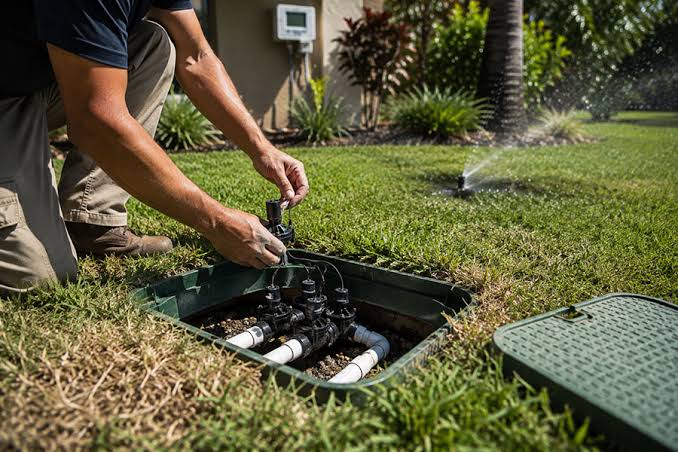
In order to avoid sustaining damage to any of the properties, it is necessary to turn off the water and the electricity. Repairs involving leaks, faults in the electrical system, valve changes, or pressure problems should be carried out by a professional irrigation specialist.
When Professional Diagnosis Is Helpful
It is necessary to seek assistance after determining multiple systems which are not working, flooding valves, cords being damaged or broken down, leakages appearing after head replacement, and if your lawn is still not levelled after these replacements. This examination will help to solve the issues as damaged heads, uneven pressure, faults in rain sensor, and wrong settings in the controller.
While searching for a specialist make sure the inspection will include checking heads, nozzles, valves, pipes, pressure, wirings and control programming. The specialists in charge for designing, installing, maintaining, repairing and auditing irrigation systems can have irrigation certification program from EPA.
Homeowner Troubleshooting Checklist
- Inspect all the zones during daylight hours.
- Make a note of broken, raised, nonfunctional, blocked, or underground sprinkler heads.
- Look for patches of water, damp soil, and leaks.
- Make sure the grass gets water instead of the pavement or adjacent structures.
- Check the controller, rain sensor, and watering schedule.
- If the coverage is uneven, you may conduct a catch-can test.
- Fix only the prominent issues that are easy to detect.
- Reach out for help if there are leaks underground, defective wires, or issues with pressure, etc.
FAQs
Why does the grass on some parts of my lawn stay dry when sprinklers run?
The reason could be the uneven distribution of water reaching the roots. The most common reasons why this occurs consist in clogged spray heads, clogged nozzles, ineffective distribution, wrong pressure, and soil compacting. Just running the sprinklers for a long time does not guarantee proper water distribution.
How often should I check the sprinklers?
The checking of sprinklers should be done from time to time during the growing season as well as after heavy rains or lawn problems that appeared because of different mowing, landscaping as well as bills.
When should I replace something instead of trying to fix it?
Replacement is an option worth contemplating when many parts keep breaking repeatedly, there is poor coverage in many zones, or repairs seem to cost more than replacing the problem part.
Final Thoughts
Correct irrigation problem solving follows the establishment of sufficient evidence rather than long runtime duration. It is necessary to check all individual zones and determine whether any problems occur with watering quality either by water being applied to the whole target area of applying or overspending the watering zone. In Palm Beach County, timely executed repair works results into promising protection of the lawn, minimal water waste as well as effective watering.
